The irony of modern economics

One of the most amazing ironies of modern Western civilization is, to me, that a few hundred years ago, some economists convinced all Christendom that self-centeredness and greed were actually virtues rather than vices, and would benefit society! The idea, of course, was that if I pursue making my business succeed with all speed, (in order to make more money for myself), my competitors will be doing the same to keep up, and everyone will benefit by better products, more efficient processes, and an increased economic activity in society all around.

One of the things that could be observed was that the traditional Christian virtues were a bit better entrenched in society back then (John Wesley said work as hard as you can for your business to succeed, as long as it doesn’t hurt your neighbor’s business!), but more importantly, this self-centeredness as economic driving force is neither biblical nor good, in the long run, for the world. The theory is that enlightened self-interest will serve as a brake from anyone carrying their selfishness too far… as chopping down too many trees would cut into the sustainability of their bottom-line. However, history has shown that in a world of transnational corporations, this doesn’t actually work.

The modern economy runs almost exclusively on short-term profits, and short term profits erase all notions of long-term environmental sustainability. Humanity’s footprint in the natural world was a lot smaller 300 years ago. If a farmer farmed his land the way transnational corporations “manage” our environment, he’d be looking at a desert within five years. Good farmers know there is much about nurture rather than production that needs to be taken into account, if you want that land to make food for your grandchildren’s generation. In our world today, it is, most often, the people at the bottom of the economic ladder, the poorest of the poor, who bear the brunt of the environmental damage, because they have the least power and voice in the society to make a big deal out of it and apply pressure.

Schumacher makes this point about the dysfunction of classic Western economics in ‘Small is Beautiful:  Economics as if People Mattered.’ I will post his quote in a few days.
I’m moving to SE Asia

So, I’m a bit late in posting, as some rapid developments in our lives here have resulted in something exciting and new: my family and I are moving at the end of the summer to SE Asia where we have accepted a position in our denomination. More on that in the future. In the meantime, I promised some more from E.F. Schumacher’s Small Is Beautiful: Economics As If People Mattered, from 1973. And here it is… Schumacher starts the book with the following two quotes:

“Few can contemplate without a sense of exhilaration the splendid achievements of practical energy and technical skill, which, from the latter part of the seventeenth century, were transforming the face of material civilization….

If, however, economic ambitions are good servants, they are bad masters.

The most obvious facts are the most easily forgotten. Both the existing economic order and too many of the projects advanced for reconstructing it break down through their neglect of the truism that, since even quite common men have souls, no increase in material wealth will compensate them for arrangements which insult their self-respect and impair their freedom. A reasonable estimate of economic organization must allow for the fact that, unless industry is to be paralyzed by recurrent revolts on the part of outraged human nature, it must satisfy criteria which are not purely economic. “

  • H. Tawney, Religion and the Rise of Capitalism

“By and large, our present problem is one of attitudes and implements. We are remodeling the Alhambra with a steam-shovel, and are proud of our yardage. We shall hardly relinquish the shovel, which after all has many good points, but we are in need of a gentler and more objective criteria for its successful use.”

  • Aldo Leopold, A Sand County Almanac

Fritz Schumacher’s 1973 ‘Small is Beautiful’

I’ve been reading an interesting book lately: E.F. “Fritz” Schumacher’s 1973 Small is Beautiful: Economics As If People Mattered. Schumacher was a British economist for England’s coal industry. His book argues that economics, and institutions in general, should be built upon a “human scale.” Schumacher observed that our modern human institutions tend to grow to such a scale that they are like frankenstein monsters which grow so large that they come back upon their masters and devour them (my image, not his). Another way you could put it is that our economies/institutions/etc cease being our servants and instead become our masters. Sudddenly the humans don’t matter in the decision-making, it’s the self-perpetuation of the larger structures we’ve created. Our creations come to lord it over us and be too big for us to control or direct in a way to promote human thriving.

It’s a very interesting book, and one that drew quite a bit of interest in the world of economists and international development policy makers back when it was written.

Schumacher argues for things like:

De-centralized, local decision making that takes the long-term good of the community as its goal, not short-term profits for a select few in some faraway metropolis.

A critique of systems that grow too gigantic or destructive of human and ecological well-being.

The need for some limiting principle, to enable a society at some point to legitimately say “enough!”

The recognition that economic profit is not the grounding, priniciple manner to gauge human well-being and the failure of modern economic thought to calculate non-economic factors into policy-makers’ decisions

The concept of intermediate technology – simple, nonviolent and controllable – (or, simple, cheap, small, safe): useful in the local situation and not forcing us to develop giant schemes

A changed view of labor and production where work is elevated to a vocation and labor and ownership aren’t mutually contradictory antagonists

The contention that Third World poverty is a question of “two million villages,” as Gandhi argued, and thus that concentrated endeavors in urban settings merely concentrated the benefits into the hands of a very select few, and the villages stayed in abject poverty

The contention that humanity should adapt within Earth’s ecosystems instead of trying to dominate (and typically destroy) them

The need to return to the Four Cardinal virtues:  prudential, justitia, fortitudo, and temperantia

As I said, it’s a very interesting read, and I’ll include some excerpts in the next few blogs.

Celtic Christian Prayers

Despite the fact that people roll their eyes at all things Celtic as a fad, I’ve been blessed in many ways by Celtic Christian spirituality. One of the things I was reminded this morning at the beach was ancient Celtic Christianity’s optimistic view of God’s protection, their awareness of God’s presence in every little aspect of daily life, and their view of life with God being full of wholehearted commitment, rather than a losing battle with sin.  These are some of the prayers I read and prayed this morning from Celtic Daily Prayer: Prayers and Readings from the Northumbria Community.

I pray the protection of Christ to clothe me.

Christ to enfold me,

To surround me and guard me

This day and every day,

Surrounding me and my companions,

Enfolding me and every friend.


The keeping of Christ about me,

The guarding of God with me

To possess me, to protect me

From drowning and danger and loss,

The gospel of the God of grace

From brow to head

To sole of foot,

The gospel of Christ,

King of salvation,

Be as a mantle to my body.


 Peace between me and my God.

 On your path, O my God,

And not my own,

Be all my journeying.

Rule this heart of mine

that it be only Yours.


All I speak

Be blessed to me, O God.

All I hear

Be blessed to me, O God.

All I see

Be blessed to me, O God.

All I sense

Be blessed to me, O God.

All I taste

Be blessed to me, O God.

Each step I take

Be blessed to me, O God.


In Your mercy, Lord,

Keep us free from sin,

And protect us from all anxiety

As we wait in joyful hope

For the coming of our Savior,

Jesus Christ,

Let Your Kingdom come, Lord, in me.

Prayer as Gardening (not gardening as prayer)

I’m not talking about gardening as prayer. That’s a good subject, and one that many devout people: Christian, Sufi, Buddist, etc etc could agree upon. But I am not talking about that. I am talking about prayer as gardening.

Praying for people affords me all the joys of gardening: watching things develop, grow, change, bear fruit, thrive, rejuvenate, be healed, etc. Often the “things” are people.  All of the wonderful things about gardening, but you can do it from any distance.

If humanity’s vocation, given by God at the beginning, is to till the earth, to steward, manage, tend, and develop the Creation, reflecting the imago dei into the Creator’s world as his appointed regents, then prayer is one of the profoundly incredible ways we are able to do that. Pascal called prayer God granting us the dignity of causation. Aside from the formation, shaping and transformation I myself experience in prayer, I am tending the Creator’s world. This is an act of love of world-shaping significance.

What a joy it brought me this past week at a conference in Missouri, to be able to walk up to people I cherish and say to them “I’ve been praying for you every day. For your health, safety, protection, your children, your marriage, your spouse, your own happiness, and fulfillment in what God has you doing.”

Praying is like Jean Giono’s marvelous parable The Man Who Planted Trees. I am not only communing with God, I am gardening the world.

The Optimism of The Kingdom

The Strengthfinders assessment lists “positivity” as one of the top 5 ways that I’m hardwired. When I read their detailed description, it did sound like me, and most everyone who knows me remarks about being upbeat and optimistic; however, I don’t think I’m an optimist by nature. In fact, as I think about my childhood, I think I was born tempermentally pessimistic.

It’s the Gospel of Jesus that makes me an optimist.

When I became serious about being a Christian at age 14, my outlook drastically changed. A couple decades ago I became aware that folks in my tribe (Nazarene) were using a phrase “the optimism of grace.”  I think this is a good phrase.

Here are some things that make me optimistic:

Nothing we do for the Lord is in vain.

The Spirit of Jesus is loose in the world, and you can’t stop Him.

The Creator God is about restoration, redemption, healing what is broken.

God is present, right here with me.

The Creator of the world believes mercy triumphs over judgment.

Jesus came to set the captives free.

God’s Spirit develops in us love joy peace patience kindness goodness faithfulness gentleness and self-control.

The Gospel brings us hope, joy, laughter, deep heart contentment, and a meaningful purpose in life.

God did not send his Son into the world to condemn the world, but to save the world through him.

God isn’t willing that any should perish but that all might come to repentance and new life.

The earth is full of Yahweh’s glory, He is everywhere, and nothing is more powerful than Him.

So I don’t believe in handwringing, woe-is-me religion. Rather than seeing every day as “a losing battle against sin” (an awful phrase I read somewhere recently), I see it as another day the mustard-seed Kingdom has grown yet larger. And that makes me an optimist.

Michael Ramsey on goodness and prayer

Michael Ramsey (1904-1988) was the 100th Archbishop of Canterbury in the Church of England and held the office from 1961 to 1974. Ramsey was engaging many of the issues we are facing today early on. If you read the Wikipedia entry (!) about him and find him a kindred spirit, I recommend  ‘Through the Year with Michael Ramsey’ edited by Margaret Duggan. Below are two things he has said.

“God’s purpose is like a stream of goodness flowing out into the world and all its needs. But it is our privilege as God’s children to help this stream of goodness to reach other people, becoming ourselves like channels. Our good actions can be channels of God’s goodness, and so too can our prayers.  ….We do not bombard God with our desires; no, we bring our desires into tune with His, so that He, waiting upon our cooperation, and using the channel of our prayers, brings the stream of His good purpose into the parched deserts of human need.”

and

“Our service in Christ’s name to those who suffer is not something that we do to try to advertise Christianity as a good, useful public show. Our service to people who suffer is just a natural outflowing of our love of God, of our love of others.  ….Every Christian congregation should, as a true part of Christian discipleship, be setting itself deliberately to the task of helping and caring for those who suffer.”

Chopping down Louisiana’s forests to meet Europe’s energy goals

Humanity’s original vocation in Scripture (never rescinded) is to steward God’s property, the planet. As a can’t-get-enough hunter and fisher, backpacker, gardener and all around nature lover, I’ve always been interested in our world’s biomes and their health. It’s one of the reasons I did an MA in International Development.

Western Europe wants green energy. Good so far. They’ve decided wood pellets are green. They call it “biomass energy.” Problem: Western Europe doesn’t have jack for forests. So they’re getting their wood pellets from the southeast USA. 2.5 million tons in 2008, which jumped to 9 million tons in 2012. They want 20 million tons annually by 2020. That 20 million tons annually is planned to come primarily from the US and Canada.

That’s a lot of clearcutting.

And as far as following established limits, in 2008 activist Dean Wilson traced bags of cypress mulch at Walmart and Home Depot labeled “sustainably harvested” back to the Atchafalaya Basin. The Basin’s cypress swamps serve as a hurricane-absorber for the coast, and are a refuge for all manner of wildlife. Due to the past, when Big Business says cypress aren’t being cut down, environmentalists are leery to believe it again. Plus, clear –cut areas can rejuvenate, but the biome for wildlife is catastrophically altered overnight, and the hurricane-mitigating abilities are wiped out until it grows back.

One questions is, how “carbon neutral” are wood pellets when used on this kind of scale?

Well, eventually, when the trees grow back, but it’s the next 50 to 100 years environmentalists are VERY worried about in terms of carbon in the atmosphere. It’s the tipping-point effects of the carbon affecting the planet’s temperature that we are concerned about now, not when the trees are sucking carbon at the rate they are now, 60 to 80 years from now.  For example, get the Ross Ice Shelf sliding faster off the Antarctic land mass than it already is… well, if that baby hits the water in one big slide, expect sea levels to go up at least 3 meters immediately. Result? Among other things, several billion people as refugees around the world, and US Senators will lose their beachfront homes.

To a large number of  American evangelicals, many of whom expect the Second Coming any minute since President Obama won a second term and their kids listen to rock music, the whole global warming/climate change discussion is a conspiracy for communists, the UN, or the Anti-Christ (or all 3) to take over the world. As a result, they’ve opted out of any serious engagement in the climate change issue, citing that they still love nature “I like going to the lake as much as the next guy…”

But for those of us Christians concerned about environmental issues, as for the wood pellets in Europe:  Is this an example of what we want to call ‘green’?

You can read the story here:

http://america.aljazeera.com/articles/2014/1/16/green-energy-demandineuropemaybethreateningamericanforests.html

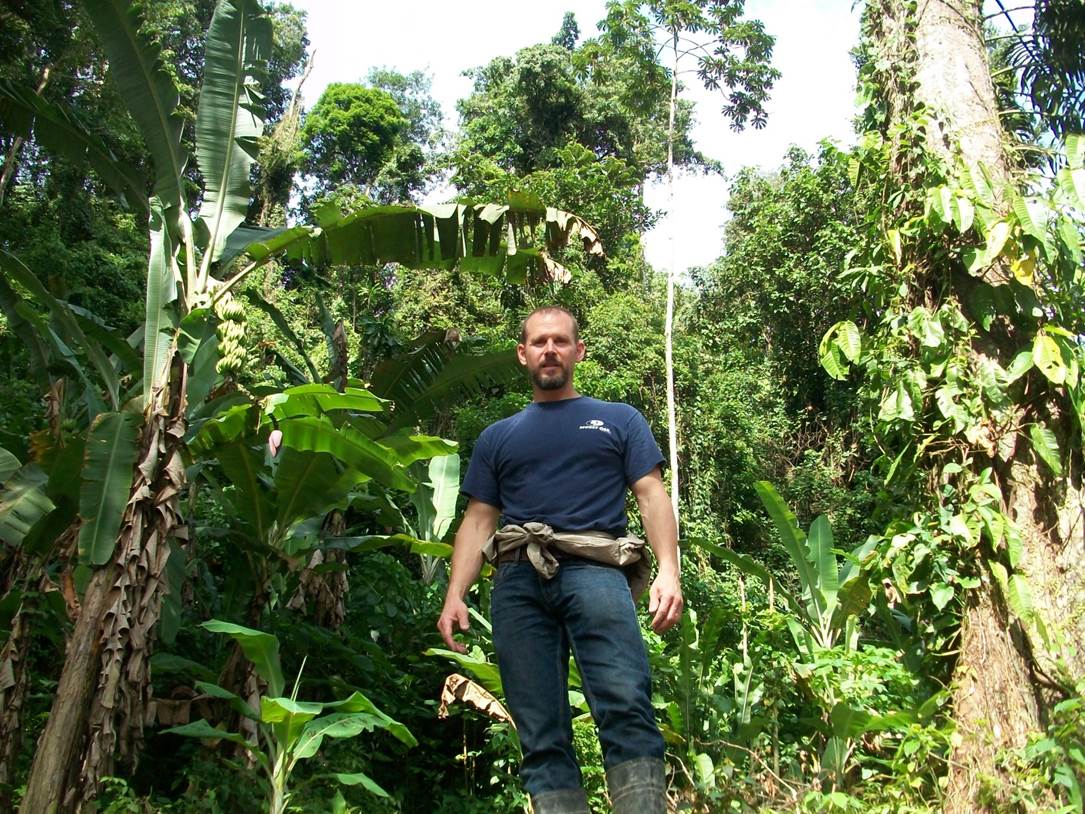
In the jungles of Costa Rica

cabecar jungle


So I’ve been AWOL for a month here, in a flurry of activity that has kept me largely away from my computer and for sure away from doing things like blogging. One of the best of these activities, in a month packed with fun, (Thanksgiving, deer hunting, etc), was a week long trip to Costa Rica, where I found myself climbing mountains in the jungle on a remote Indian Reservation doing a feasibility study for development work for an inter-agency cooperation.

From 2012-2014 I did an MA in International Development at Eastern University in St. Davids, PA at Eastern’s  (Tony) Campolo School of Leadership and Development. As a pastor, I’ve always believed in putting your money where your mouth is, and a degree in development would, I hoped, help me comprehend better how to do good work in the under-developed world, instead of blundering through with good intentions.  It was great fun and very stimulating and put me with an incredible group of people I am blessed to call friends. One of the organizations looking at development work among the Native Americans in Costa Rica knew me and asked me to come along on an assessment trip as their ‘development specialist.’ An all-expenses-paid chance to hike around in the jungle and maybe even do some good? Easy choice.  My folks paid for our 17 year old son to come along as a student observer and that made it even better.

So it was pretty sweet, interviewing folks all over, taking a look at their water and sanitation issues, and education, health services and infrastructure needs. We spent three days in the jungle and the next three days hammering out reports and sitting in long, long meetings. All in all, it was dream work. The dream job. I’m grateful to belong to a denomination with a vision for transformation of not only peoples’ spiritual lives, but all of their existence, in culturally appropriate, missiologically and anthropologically sound ways.

Brad Pailsey and LLCool J’s ‘Accidental Racist’

A couple years ago country singer/songwriter (and phenomenal guitarist) Brad Paisley got together with rapper/actor LL Cool J and released a song “Accidental Racist” on Paisely’s album ‘Wheelhouse’ (Arista Nashville, 2013). Paisely drew a fair amount of criticism for the song, citing it was too meager a response to a subject as complex and substantial as race relations in the U.S. For my own part, I found the song to be a fabulous contribution. You have to start somewhere, and a country western singer teaming up with a rapper provides a venue to speak from that activists, preachers and politicians don’t enjoy. Thank you, James and Brad.


 “Accidental Racist”

(feat. Ll Cool J)

To the man that waited on me at the Starbucks down on Main, I hope you understand
When I put on that t-shirt, the only thing I meant to say is I’m a Skynyrd fan
The red flag on my chest somehow is like the elephant in the corner of the south
And I just walked him right in the room
Just a proud rebel son with an ‘ol can of worms
Lookin’ like I got a lot to learn but from my point of view

I’m just a white man comin’ to you from the southland
Tryin’ to understand what it’s like not to be
I’m proud of where I’m from, but not everything we’ve done
And it ain’t like you and me can re-write history
Our generation didn’t start this nation
We’re still pickin’ up the pieces, walkin’ on eggshells, fightin’ over yesterday
And caught between southern pride and southern blame

They called it Reconstruction, fixed the buildings, dried some tears
We’re still siftin’ through the rubble after a hundred-fifty years
I try to put myself in your shoes and that’s a good place to begin
But it ain’t like I can walk a mile in someone else’s skin

‘Cause I’m a white man livin’ in the southland
Just like you I’m more than what you see
I’m proud of where I’m from, but not everything we’ve done
And it ain’t like you and me can re-write history
Our generation didn’t start this nation

And we’re still paying for mistakes
That a bunch of folks made long before we came
And caught between southern pride and southern blame

(LL Cool J): Dear Mr. White Man, I wish you understood
What the world is really like when you’re livin’ in the hood
Just because my pants are saggin’ doesn’t mean I’m up to no good
You should try to get to know me, I really wish you would
Now my chains are gold but I’m still misunderstood
I wasn’t there when Sherman’s March turned the south into firewood
I want you to get paid but be a slave I never could
Feel like a new fangled Django, dodgin’ invisible white hoods
So when I see that white cowboy hat, I’m thinkin’ it’s not all good
I guess we’re both guilty of judgin’ the cover not the book
I’d love to buy you a beer, conversate and clear the air
But I see that red flag and I think you wish I wasn’t here

I’m just a white man
(If you don’t judge my do-rag)
Comin’ to you from the southland
(I won’t judge your red flag)
Tryin’ to understand what it’s like not to be

I’m proud of where I’m from
(If you don’t judge my gold chains)
But not everything we’ve done
(I’ll forget the iron chains)
it ain’t like you and me can re-write history
(Can’t re-write history baby)

Oh, Dixieland
(The relationship between the Mason-Dixon needs some fixin’)
I hope you understand what this is all about
(Quite frankly I’m a black Yankee but I’ve been thinkin’ about this lately)
I’m a son of the new south
(The past is the past, you feel me)
And I just want to make things right
(Let bygones be bygones)
Where all that’s left is southern pride
(RIP Robert E. Lee but I’ve gotta thank Abraham Lincoln for freeing me, know what I mean)
It’s real, it’s real
It’s truth